7 classical Simple Machines – Physics 10
About Course

At the end of this chapter you should be able to:
- Describe what a simple machine is
- Identify the different types of simple machines.
- Describe the distances moved by the effort and the load in a simple machine
- Explain the terms of Mechanical advantage (MA), Velocity Ratio (VR) and Efficiency.
- Perform calculations involving simple machines
Definition of Simple Machine
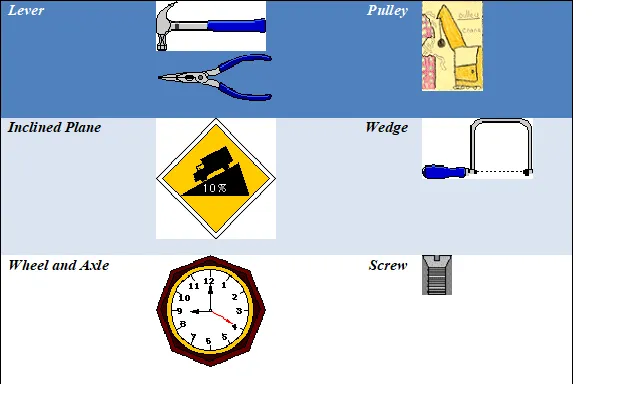
Simple machines are mechanical tools that make work easier. They have few or no moving parts. These machines use energy to work. The following are the most familiar simple machine used in everyday life
It uses a single applied force to do work against a single load force. Ignoring friction losses, the work done on the load is equal to the work done by the applied force.
They can be used to increase the amount of the output force, at the cost of a proportional decrease in the distance moved by the load. The ratio of the output to the input force is called the mechanical advantage.
Usually the term refers to the six classical simple machines which were defined by Renaissance scientists: Lever, Wheel and axle, Pulley, Inclined plane, Wedge and Screw.
Course Content
DIFFERENT TYPES OF SIMPLE MACHINES
DIFFERENT TYPES OF SIMPLE MACHINES
MECHANICAL ADVANTAGE (MA), VELOCITY RATIO (VR) AND EFFICIENCY CALCULATION OF MACHINES
Student Ratings & Reviews