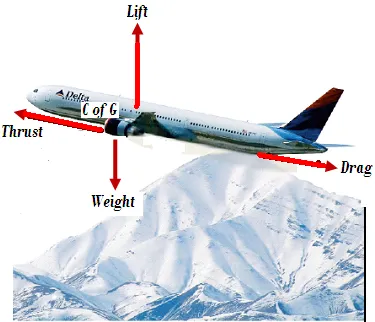
We discovered in the previous course on concepts of forces, that an acceleration results when an unbalanced force acts on a body. This situation is related to the other physical phenomenon called moment of forces.
In many cases however, a number of forces act on a body in such a way that no acceleration is produced. When this happens, we say that the body is in equilibrium. A body in equilibrium will either be at rest or in uniform motion
At the end of this chapter you should be able to:
Perform calculations based on the principle of moments.
Investigate the everyday application of moments.
" />
MOMENT OF FORCES
A
Moment of Forces
We discovered in the previous course on concepts of forces, that an acceleration results when an unbalanced force acts on a body. This situation is related to the other physical phenomenon called moment of forces.
In many cases however, a number of forces act on a body in such a way that no acceleration is produced. When this happens, we say that the body is in equilibrium. A body in equilibrium will either be at rest or in uniform motion
At the end of this chapter you should be able to:
Perform calculations based on the principle of moments.
Investigate the everyday application of moments.
">
MOMENT OF FORCES
A
Moment of Forces
We discovered in the previous course on concepts of forces, that an acceleration results when an unbalanced force acts on a body. This situation is related to the other physical phenomenon called moment of forces.
In many cases however, a number of forces act on a body in such a way that no acceleration is produced. When this happens, we say that the body is in equilibrium. A body in equilibrium will either be at rest or in uniform motion
At the end of this chapter you should be able to:
Perform calculations based on the principle of moments.
We discovered in the previous course on concepts of forces, that an acceleration results when an unbalanced force acts on a body. This situation is related to the other physical phenomenon called moment of forces.
In many cases however, a number of forces act on a body in such a way that no acceleration is produced. When this happens, we say that the body is in equilibrium. A body in equilibrium will either be at rest or in uniform motion
At the end of this chapter you should be able to:
Perform calculations based on the principle of moments.